
Cloud in 2026 From Cost Optimization Tool to Core Business Capability
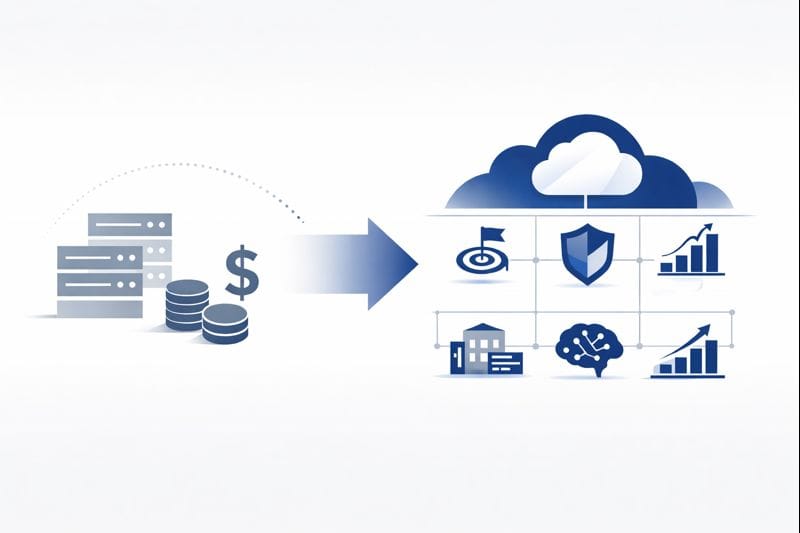
For many years cloud services were framed as a financial decision. Move to the cloud, reduce capital expenditure, pay only for what you use, and scale when needed. This narrative helped cloud adoption gain momentum, but it is no longer accurate enough for 2026. Cloud is no longer just an optimization lever. It has become a core business capability that shapes how companies operate, innovate, and compete.
Why Cloud Services Matter More Than Ever in 2026
In 2026 the most successful organizations do not ask whether they should use cloud services. They ask how mature their cloud capabilities are and how well those capabilities support business strategy. The conversation has shifted from infrastructure efficiency to organizational effectiveness.
The early cloud mindset was about replacement. Physical servers were replaced with virtual machines. Data centers were replaced with managed infrastructure. Procurement cycles were shortened and finance teams gained flexibility. This was valuable, but it was only the first step. Many companies stopped there and assumed they were done with cloud transformation.
That assumption is now a liability.
Modern cloud platforms are no longer just places to run workloads. They are environments where entire operating models are built. Product development, data usage, security practices, and even organizational structures are increasingly shaped by cloud capabilities. Companies that treat cloud as a background utility struggle to keep pace with those that treat it as a strategic foundation.
One of the biggest shifts in 2026 is how cloud enables speed as a business outcome. Speed is no longer limited to faster deployments or shorter release cycles. It includes how quickly a company can test ideas, launch new digital products, respond to regulatory changes, or integrate acquisitions. Cloud native capabilities such as managed data platforms, event driven architectures, and automated compliance controls directly influence how fast the business can move without increasing risk.
What Cloud Maturity Really Means for Leaders
This is why cloud decisions are increasingly made at leadership level, not just within engineering teams. The cloud shapes what is possible. It determines whether a company can experiment safely, scale globally, and adapt continuously. In this sense cloud becomes similar to finance or legal functions. It is part of the core machinery of the organization.
Security and governance are another area where the cloud narrative has evolved. In the past cloud security discussions were defensive. Is the cloud safe. Who is responsible. How do we avoid misconfigurations. In 2026 leading organizations approach cloud security as an enabler. Strong cloud governance allows teams to move faster with confidence. Clear policies, automated controls, and well designed architectures reduce friction rather than increase it.
This is where many companies struggle. They either over centralize control and slow everything down, or they decentralize completely and accumulate risk. Cloud maturity means finding the balance where guardrails are strong but flexible. This requires architectural thinking, not just tools.
Cloud also plays a central role in how companies adopt artificial intelligence. AI in production is not just about models. It depends on data pipelines, scalable compute, observability, and cost transparency. All of these are cloud capabilities. Organizations that already have strong cloud foundations can move from AI experiments to real business use cases much faster than those that do not.
Cloud as the Foundation for AI Adoption
In 2026 cloud platforms are increasingly the place where AI workloads live, where data is governed, and where compliance is enforced. This makes Cloud strategy inseparable from AI strategy. Treating cloud as a cost center while expecting AI to deliver competitive advantage is a contradiction that many companies are now confronting.
Another important change is how cloud maturity affects talent and culture. Engineers, data professionals, and product teams expect modern cloud environments. They expect automation, self service, and clear patterns. Companies that lack these capabilities struggle to attract and retain talent. Cloud is no longer invisible to employees. It directly shapes their daily experience of work.
A common mistake is to equate cloud maturity with multi cloud or complex architectures. In reality maturity is about clarity. Clear ownership, clear decision making, and clear alignment between business goals and technical choices. Some mature organizations use multiple cloud providers. Others deliberately standardize on one. The difference is that the decision is intentional and well understood.
By 2026 the question is no longer how much money the cloud saves. The question is how effectively it enables growth, resilience, and innovation. Cloud platforms have become the operating layer for digital business. Ignoring this reality creates strategic blind spots.
For leaders, this means cloud discussions must move beyond cost reports and technical roadmaps. They must connect cloud capabilities to business outcomes. For technology teams, it means stepping into a more advisory role and helping the organization understand what the cloud makes possible.
Cloud in 2026 is not about infrastructure. It is about capability. Companies that recognize this shift and act on it will be better positioned to adapt to whatever comes next. Those that do not will find that their cloud environments may be running, but their business is falling behind.
Cloud platforms evolve fast, but many organizations are stuck with yesterday’s cloud decisions. We help companies assess cloud maturity, identify structural gaps, and define a pragmatic roadmap that supports growth, security, and AI readiness.